
What Is a Garburator? A Calgary Homeowner’s Guide to Choosing, Using, and Maintaining Yours
It’s a regular Tuesday night in your Calgary kitchen. You’re scraping vegetable peels and leftover pasta off the dinner plates, you flip the switch under the sink, you hear that familiar low growl, and twenty seconds later your sink is clean. No bagging up wet scraps, no smelly compost bucket sitting on the counter, no worry about anything sneaking down the drain and clogging your pipes.
That little powerhouse under your sink is a garburator — one of the most quietly useful appliances in the modern Canadian kitchen. But for an appliance most of us rely on every single day, garburators are surprisingly misunderstood. What exactly are they? How are they different from “garbage disposals”? What can you put down them, and what will quickly destroy them?
At Benner Plumbing, we’ve been installing, repairing, and replacing garburators in Calgary homes since 1967. Here’s the practical homeowner’s guide our techs wish every customer had read before their service call.
What Is a Garburator?
A garburator is an electric appliance installed beneath your kitchen sink, between the drain and the P-trap, that shreds food waste into tiny particles so they can be flushed safely through your home’s plumbing system. It uses a spinning disc (called an impeller plate) and a grinding ring to break scraps into pieces small enough to be carried away with running water.
If you’re wondering why we say “garburator” instead of “garbage disposal” — you’ve spotted a uniquely Canadian quirk. “Garburator” is the term used across Canada (and parts of Australia), while “garbage disposal” or “disposal unit” is the standard term in the United States. Both refer to the exact same appliance, so don’t worry if a product label or installation manual uses one term or the other.
How Does a Garburator Work?
Despite the menacing growl, modern garburators don’t actually contain blades. Here’s what’s really happening every time you flip that switch:
- Cold water enters the chamber. You should always run cold water before, during, and for about 15 seconds after grinding — it solidifies fats so they get ground up rather than coating your pipes.
- The impeller plate spins at roughly 1,400–2,800 RPM. Centrifugal force throws food scraps outward against a stationary grinding ring on the inner wall.
- The grinding ring shreds the scraps. The ring is lined with sharp ridges that pulverize food into particles roughly 2mm or smaller — small enough to pass through a standard drain line.
- Water flushes the particles into the drain. The slurry exits through the discharge tube into the P-trap and continues to the main sewer line or septic system.
The entire process usually takes less than 30 seconds for an average load of scraps.
Garburator vs. Garbage Disposal: Is There a Difference?
Functionally? None. The two terms describe the same appliance. The differences you’ll actually run into when shopping for one are about features and quality tier, not the name on the box:
- Continuous-feed models run the whole time the switch is on — most common in Canadian homes.
- Batch-feed models only operate when a stopper is in place — slower, but safer if you have curious kids.
- Motor horsepower (HP) ranges from 1/3 HP to 1 HP. Higher HP means quieter operation, fewer jams, and the ability to grind tougher waste like small bones or fibrous vegetable stems.
- Stainless-steel grinding components last longer and resist corrosion better than the galvanized parts in budget models — particularly important in Calgary, where hard water can accelerate wear.
What Should You Avoid Putting in a Garburator?
Even a high-horsepower garburator has limits. Most of the emergency calls we get for jammed or broken units come back to one of the same culprits. Keep these out of yours:
- Grease, oil, and fat. These coat your pipes downstream of the garburator and harden into clogs that no amount of grinding will fix.
- Fibrous vegetables. Celery, corn husks, asparagus, artichokes, and onion skins wrap around the impeller and seize the motor.
- Starchy foods. Pasta, rice, and bread swell when wet and form a gummy paste that blocks the drain line.
- Bones and fruit pits. Beef bones, peach pits, avocado pits — anything dense enough to chip the grinding ring. Soft chicken bones are usually fine in higher-HP models.
- Coffee grounds. Counterintuitive, but coffee grounds accumulate in the trap and become a major clog over time.
- Eggshells. Despite the popular myth that eggshells “sharpen the blades,” the inner membrane wraps around moving parts and the shell fragments build up in pipes.
- Non-food items. Twist ties, bottle caps, cutlery — sounds obvious, but it’s the number-one cause of catastrophic motor failure we see in service.
When in doubt: if it’s tough, fibrous, expandable, or greasy, it belongs in the green cart, not the garburator.
Common Garburator Problems (and What to Do)
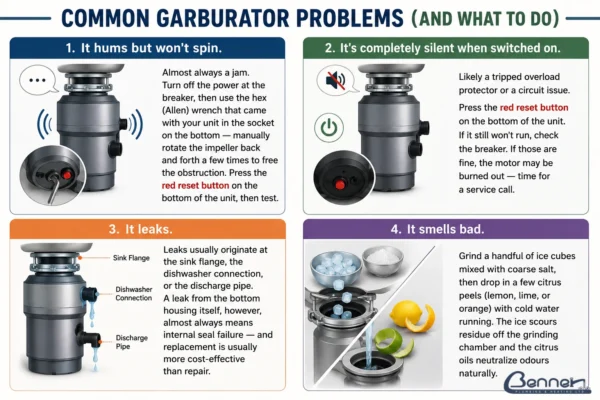
It hums but won’t spin.
Almost always a jam. Turn off the power at the breaker, then use the hex (Allen) wrench that came with your unit in the socket on the bottom — manually rotate the impeller back and forth a few times to free the obstruction. Press the red reset button on the bottom of the unit, then test.
It’s completely silent when switched on.
Likely a tripped overload protector or a circuit issue. Press the red reset button on the bottom of the unit. If it still won’t run, check the breaker. If those are fine, the motor may be burned out — time for a service call.
It leaks.
Leaks usually originate at the sink flange, the dishwasher connection, or the discharge pipe. A leak from the bottom housing itself, however, almost always means internal seal failure — and replacement is usually more cost-effective than repair.
It smells bad.
Grind a handful of ice cubes mixed with coarse salt, then drop in a few citrus peels (lemon, lime, or orange) with cold water running. The ice scours residue off the grinding chamber and the citrus oils neutralize odours naturally.
How to Maintain Your Garburator
A few simple habits will extend the life of your unit by years:
- Always run cold water before, during, and 15 seconds after each use.
- Grind small amounts at a time — don’t overload the chamber.
- Never use chemical drain cleaners. They corrode internal components and seals.
- Once a month, freshen the chamber with the ice-and-citrus trick described above.
- Run the unit at least once every few days, even if you don’t have scraps — sitting unused causes corrosion and odour.
When Should You Replace Your Garburator?
A well-maintained garburator typically lasts 8–15 years. Signs you’re due for replacement:
- Frequent jams and resets, even with proper use
- Grinding noises that have become noticeably louder over time
- Persistent leaks from the unit housing (not just connections)
- Slow grinding — what used to take 15 seconds now takes a minute
- Visible rust on internal components when you shine a flashlight inside
If your unit is more than 10 years old and showing two or more of these symptoms, replacement is almost always more cost-effective than repair. Newer units are quieter, more efficient, and use stainless-steel components designed to handle Calgary’s hard water.
Frequently Asked Questions About Garburators
- Can I put bones in a garburator?
Soft, small bones such as chicken or fish bones are usually fine in higher-horsepower (3/4 HP or 1 HP) garburators. Larger bones — beef, pork, or steak bones — should always go in the green cart. They’ll either jam the unit or chip the grinding ring.
- How long does a garburator last?
A well-maintained garburator typically lasts 8–15 years. Higher-end stainless-steel units last longer than budget galvanized models, and units that are used regularly (but not overloaded) outlast ones that sit unused for weeks at a time.
- Why does my garburator smell bad?
Smells come from food residue stuck on the grinding components and the rubber splash guard at the top of the unit. Grind a handful of ice cubes mixed with coarse salt, drop in some citrus peels (lemon, lime, or orange) while running cold water, and wipe down the rubber splash guard with warm soapy water. Repeat monthly to keep it fresh.
- Is it safe to put my hand in a garburator?
Never put your hand into a garburator while it’s plugged in, even if the switch is off. If you need to retrieve an object or clear a jam, always turn off the power at the breaker first. The grinding components don’t have blades, but they can cause serious injury if the unit activates unexpectedly. Use long-handled tongs or pliers — never your fingers.
- Can I run my dishwasher and garburator at the same time?
Yes — in fact, most dishwashers drain through the garburator. Just make sure the dishwasher connection (called a “knockout plug”) was removed during installation, otherwise the dishwasher won’t drain properly. If you’re unsure, give us a call before running your dishwasher.
- How much does it cost to install a garburator in Calgary?
Installation typically ranges from $300–$600 in the Calgary area, depending on the unit you choose and whether your existing plumbing requires modification. Replacement of an existing unit is on the lower end of that range; first-time installations (which require new wiring and a switch) cost more. Reach out for a free quote and we can give you an exact number for your kitchen.
- Do I need a garburator if I already compost?
Many Calgary homeowners use both. The green cart handles vegetable peels and yard waste well, but a garburator is more convenient for small bits of food that get rinsed off plates, and it eliminates the smell of a compost bucket sitting in the kitchen between cart pickups. Use them together — compost the bulk, grind the leftovers.
- Why won’t my garburator turn on at all?
Almost always one of three things: the unit tripped its built-in overload protector (press the red reset button on the bottom of the unit), the breaker tripped (check your electrical panel), or the motor has burned out. If the reset button and breaker are both fine and the unit is silent, it’s time for a service call.
Need Garburator Installation or Repair in Calgary?
Whether you’re upgrading an old unit, replacing one that’s finally given up, or installing a garburator in your kitchen for the first time, Benner Plumbing has been the trusted name for Calgary plumbing and heating since 1967. Our fleet of 10 service vans covers Calgary, Cochrane, Airdrie, Okotoks, and Chestermere, and our showroom on Edmonton Trail NE carries a full range of garburators from trusted brands to suit any kitchen and budget.
Browse our garburator selection in store, or call us anytime to book a same-day installation.
Ready to upgrade your garburator?
Visit our Calgary showroom at 4528 Edmonton Trail NE, or call (403) 276-1388 to schedule an installation or repair. After-hours emergencies welcome — we’re here 24/7.